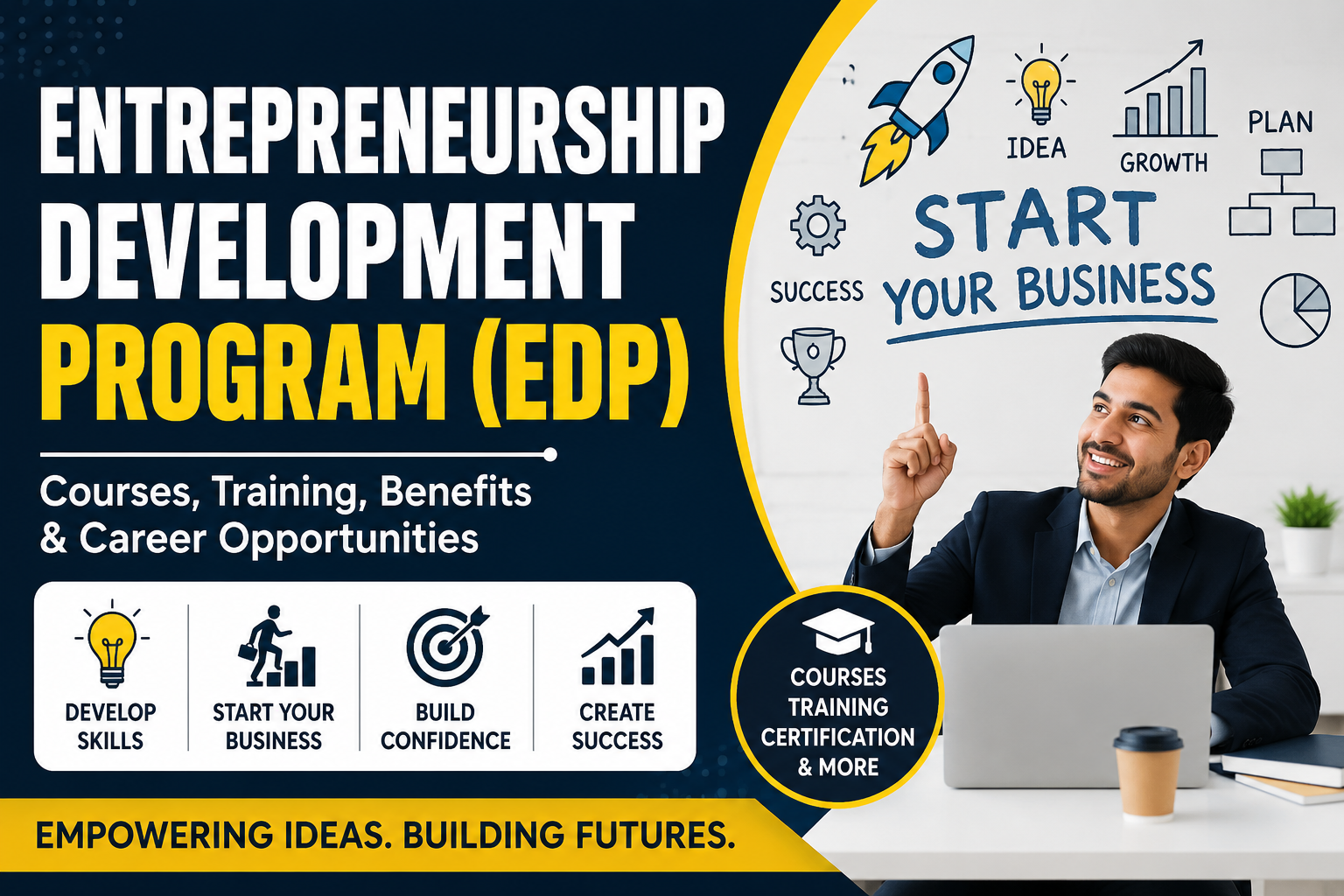
Entrepreneurship Development Program (EDP) | Courses, Training, Benefits | Career Guide
An Entrepreneurship Development Program (EDP) is a structured training initiative designed to identify, train, and nurture potential entrepreneurs. The primary goal of an EDP is to equip individuals with the knowledge, skills, attitudes, and motivation required to start and successfully manage their own business ventures.
Whether delivered by a government body, university, MSME development center, or private institute, an EDP entrepreneurship development programme typically covers business planning, financial management, market research, leadership, and innovation — the core pillars every entrepreneur needs.
The concept of EDP first gained traction in India during the 1970s and has since grown into a nationwide ecosystem involving institutions like the National Institute for Entrepreneurship and Small Business Development (NIESBUD), MSME Development Institutes, and various state-level bodies.
One critical thing every EDP participant should know early: once you complete your training and decide to start a business, the very first official step is to register your enterprise under Udyam Registration Portal — the Government of India's free, paperless portal for recognising Micro, Small, and Medium Enterprises (MSMEs). Without this registration, your business cannot access most of the government schemes, subsidies, and benefits that EDPs help you qualify for.
Why Is an Entrepreneurship Development Programme Required to Help?
An EDP (entrepreneurship development programme) is required to help address several critical challenges in India's economic landscape:
-
Unemployment — EDPs train individuals to become job creators rather than job seekers, directly tackling unemployment in rural and semi-urban areas.
-
Economic growth — New businesses generate wealth, tax revenue, and GDP growth. The MSME sector alone contributes over 30% to India's GDP.
-
Innovation — Entrepreneurial training fosters an entrepreneurial mindset development programme that encourages people to solve real-world problems creatively.
-
Social equity — Programs targeting women, youth, and rural communities promote inclusive economic development.
-
MSME ecosystem building — Every trained entrepreneur who formalises their business strengthens India's MSME backbone, unlocking credit, subsidies, and procurement priority.
For students, an entrepreneurship development programme for students provides early, practical business grounding. For working professionals, it offers a credible path to business ownership. For micro-entrepreneurs, it provides the skills to formalise and scale.
Types of Entrepreneurship Development Programs in India
1. Government-Backed Programs
Several government programmes for entrepreneurship development exist at the central and state level. Nearly all of them require official MSME registration as a prerequisite for receiving financial assistance.
a) MSME Entrepreneurship Development Program
Run by the Ministry of MSME through its Development Institutes (MSME-DI), the MSME entrepreneurship development program offers short-term training in product development, quality control, marketing, and government schemes. After completing this program, participants are guided to complete their MSME registration and apply for available benefits.
b) DST-NIMAT Entrepreneurship Awareness Camp
The DST NIMAT Entrepreneurship Awareness Camp is conducted by the National Institute for Micro, Small and Medium Enterprises (NI-MSME). These camps raise awareness among college students about business opportunities and educate them about the official MSME registration process as their enterprise's first compliance requirement.
c) Chief Minister Entrepreneurship Development Program
Many state governments run a Chief Minister Entrepreneurship Development Program to support first-generation entrepreneurs with seed funding, mentorship, and market linkages. These programs typically mandate proof of enterprise registration before disbursing financial assistance or subsidies.
d) Ayush Entrepreneurship Development Programme
The Ayush Entrepreneurship Development Programme supports individuals building businesses in traditional medicine and wellness — Ayurveda, Yoga, Unani, Siddha, and Homeopathy. Businesses set up under this initiative can register as MSMEs and avail manufacturing-sector benefits.
e) Rural Entrepreneurship Development
Focused on village-based enterprises, rural entrepreneurship development programs train rural youth and women in handicrafts, food processing, animal husbandry, and agro-processing. The development of rural entrepreneurship is a key priority under PMEGP and NRLM — both of which require official MSME registration for loan subsidy release.
2. Academic Programs
Universities and B-schools offer degree and diploma-level entrepreneurship education. These programs produce graduates well-equipped to launch MSME ventures and navigate the government registration and scheme ecosystem.
a) MBA in Innovation, Entrepreneurship and Venture Development
The MBA in innovation entrepreneurship and venture development combines business fundamentals with startup thinking, venture capital knowledge, and innovation management. The MBA innovation entrepreneurship and venture development scope is broad — graduates launch startups, join accelerators, or lead corporate innovation teams.
b) Diploma in Entrepreneurship Development
A diploma in entrepreneurship development is a shorter, skill-focused credential. Diploma holders who start manufacturing or service enterprises qualify for MSME status and should complete their official registration immediately upon beginning operations.
c) Certificate in Entrepreneurship Development
A certificate in entrepreneurship development is offered by NIESBUD, IIMs, and state entrepreneurship development cells. These short-term certifications often include a dedicated module on government registration as part of the business launch curriculum.
d) Certificate in Skill and Entrepreneurship Development
The certificate in skill and entrepreneurship development bridges vocational training and business ownership, helping skilled workers — carpenters, tailors, mechanics, beauticians — transition into enterprise owners. Once they set up their unit, official MSME registration classifies them as micro or small enterprises and unlocks credit and subsidy access.
e) Entrepreneurship Development Course Online
An entrepreneurship development course online is now available on SWAYAM, Coursera, and NIESBUD's portal. Many online programs include step-by-step guidance on business registration and compliance as part of their launch module.
3. Institutional Programs
a) Entrepreneurship Development and Innovation Institute (EDII)
The Entrepreneurship Development and Innovation Institute (EDII) in Ahmedabad is India's premier institution for entrepreneurship education. EDII programs actively guide participants toward MSME formalisation as a concrete, measurable outcome of their training.
b) Entrepreneur Development Cell
Many colleges now have an entrepreneur development cell — an internal hub where students receive mentorship, incubation support, seed grants, and networking access. These cells also help student-entrepreneurs with business registration from day one.
c) Entrepreneur Assistance Center
An entrepreneur assistance center provides hands-on support for early-stage entrepreneurs — from business plan writing to legal compliance. A core service is helping new entrepreneurs understand which MSME category (Micro, Small, or Medium) they qualify for based on their investment and turnover.
Key Components of an Entrepreneurship Development Training Program
A well-designed entrepreneurship development training program covers these essential modules:
1. Entrepreneurial Mindset Development Risk tolerance, creativity, resilience, and problem-solving — the psychological foundation every entrepreneur needs before they take the plunge.
2. Business Planning and Strategy Business model canvas, market assessment, value proposition, and financial projections form the backbone of any successful entrepreneurship development plan.
3. Financial Literacy and Funding Understanding working capital, P&L, balance sheets, and funding options — PMEGP, MUDRA, CGTMSE — all of which require official MSME registration as a prerequisite.
4. Marketing and Sales Digital marketing, branding, pricing strategy, and customer acquisition tailored to the MSME market context.
5. Legal and Regulatory Compliance GST registration, company incorporation, labour law basics, IP protection, and MSME registration as the foundational compliance step for any new enterprise.
6. Government Schemes and Subsidies A dedicated module covering PMEGP, MUDRA, ZED, Stand Up India, and GeM — each requiring valid MSME registration before an application can be submitted.
7. Innovation and Technology Adoption Digital tools, e-commerce setup, social media marketing, and industry-specific technology for new businesses, especially important for entrepreneurs in Tier 2 and Tier 3 cities.
Entrepreneurship Development Programme for Women
Women-focused entrepreneurship development programmes for women are a major policy priority in India. Initiatives like STEP, WEP (Women Entrepreneurship Platform by NITI Aayog), and state-level schemes provide microloans, skill training, market access, and mentorship.
Women entrepreneurs who register their enterprise as an MSME are classified as women-owned MSMEs, unlocking additional benefits:
-
Priority under Stand Up India (loans from ₹10 lakh to ₹1 crore)
-
Mahila Udyam Nidhi scheme support
-
Preferential treatment in government procurement on GeM
-
Access to women-specific incubators and accelerators
Entrepreneurship Development Programme for Micro Entrepreneurs
The entrepreneurship development programme for micro entrepreneurs targets India's smallest business owners — street vendors, home-based workers, and artisans with investments under ₹1 crore in manufacturing or ₹50 lakh in services.
These entrepreneurs qualify as Micro Enterprises under the MSMED Act. Formalising their business through MSME registration gives them:
-
A legal enterprise identity recognised by banks and government
-
Access to PMEGP and MUDRA loans
-
Legal protection against delayed payments under the MSMED Act
-
Entry to government markets via GeM (Government e-Marketplace)
Ministry of Skill Development and Entrepreneurship
The Ministry of Skill Development and Entrepreneurship is the nodal body governing skill training and entrepreneurship promotion in India. Key initiatives include:
-
PMKVY — Pradhan Mantri Kaushal Vikas Yojana
-
SANKALP — Skills Acquisition and Knowledge Awareness for Livelihood Promotion
-
Ministry of Skill Development and Entrepreneurship courses — available on the Skill India portal
The ministry of skill development and entrepreneurship certificate validates participation in approved training programs. Most certified trades and skills can be directly converted into registered micro or small enterprises — making skill certification followed by MSME registration a natural two-step process.
National Institute for Entrepreneurship and Small Business Development (NIESBUD)
The National Institute for Entrepreneurship and Small Business Development (NIESBUD) is India's apex body for entrepreneurship training and research. NIESBUD:
-
Designs EDP curricula for institutions across India
-
Trains trainers and master trainers
-
Conducts research on entrepreneurship trends
-
Runs direct training programs for aspiring entrepreneurs
NIESBUD programs consistently emphasise official MSME registration as a mandatory post-training action — because an unregistered enterprise cannot access the full ecosystem that EDP training prepares participants for.
Government Policy and Programs for Entrepreneurship Development
Here is a quick reference of major government schemes and whether MSME registration is required:
|
Scheme
|
What It Offers
|
MSME Registration Required?
|
|
PMEGP
|
Subsidy-linked loans up to ₹50 lakh
|
✅ Yes
|
|
MUDRA Yojana
|
Collateral-free loans (Shishu / Kishore / Tarun)
|
✅ Yes
|
|
Stand Up India
|
Credit for SC/ST and women entrepreneurs
|
✅ Yes
|
|
ZED Certification
|
Quality certification with 50–80% subsidy
|
✅ Yes
|
|
CLCSS
|
Technology upgrade subsidy
|
✅ Yes
|
|
GeM Registration
|
Sell directly to government buyers
|
✅ Yes
|
|
Startup India
|
Tax exemption, patent fast-track
|
Recommended
|
As the table makes clear, MSME registration is not optional — it is the entry ticket to India's entire government support ecosystem for small businesses. Every EDP that trains participants in these schemes must ensure they complete their Udyam Registration before applying, as it is the officially recognised proof of MSME status accepted across all these programs.
Basic Entrepreneurship and Skills Training Program
The Basic Entrepreneurship and Skills Training Program (BEST) is a foundational intervention for individuals with little or no business background — school dropouts, rural youth, BPL women, and unemployed graduates in smaller cities.
After completing BEST training, participants are guided to start a micro enterprise and complete MSME registration — transforming them from informal workers into officially recognised entrepreneurs with access to credit and government support.
Entrepreneur Awareness Programme
An entrepreneur awareness programme is typically a one or two-day event that creates the initial spark of entrepreneurship. It introduces participants to:
-
Self-employment concepts and business opportunities
-
Government schemes available for MSMEs
-
Inspiring success stories of first-generation entrepreneurs
-
The simple, process of MSME registration — which takes under 30 minutes online
These are organised by District Industries Centers (DICs), KVIC, MSME-DIs, and college entrepreneurship development cells.
EDP Curriculum: Week-by-Week Breakdown
A standard entrepreneurship development programme runs 4–6 weeks. Here is a typical structure:
Week 1–2: Opportunity Identification Market scanning, customer discovery, business feasibility analysis
Week 3–4: Business Planning Business model canvas, financial projections, operational and marketing strategy
Week 5: Compliance, Schemes, and Registration Accounting basics, GST filing, digital marketing — and a hands-on session on MSME registration, understanding investment and turnover limits, and scheme application processes
Week 6: Launch Preparation Pitch practice, investor readiness, GeM onboarding, scheme applications using the MSME registration number
Need for Entrepreneurship Development Programmes: Summary
The need for entrepreneurial development programme in India today is stronger than ever:
-
Demographic dividend — 65% of India's population is below 35. EDPs channel this energy into productive enterprise.
-
Informal economy — Crores of unregistered businesses operate informally. EDPs combined with MSME registration bring them into the formal economy.
-
Rural livelihoods — Agricultural distress makes rural entrepreneurship development a livelihood imperative.
-
Women empowerment — Economic independence through business ownership is a proven path to gender equity.
-
Import substitution — Trained MSME entrepreneurs produce locally what India currently imports.
-
Post-COVID recovery — Small businesses need both skills and formal recognition to rebuild and access credit.
Step-by-Step: From EDP Training to Launching Your MSME
Here is the practical roadmap every EDP participant should follow:
Step 1: Enroll in an EDP through NIESBUD, MSME-DI, EDII, or your state government's entrepreneurship development cell.
Step 2: Complete the training and finalise your business idea, structure, and investment plan.
Step 3: Complete your MSME registration on the official portal — , Aadhaar-based, and instant. Your registration certificate is generated immediately.
Step 4: Use your registration number to apply for PMEGP, MUDRA, or other schemes your EDP training covered.
Step 5: Register on GeM (Government e-Marketplace) to access government procurement orders.
Step 6: Continue building with the mentorship, networks, and knowledge gained through your EDP, now backed by official MSME recognition.
Conclusion: EDP Training and Udyam Registration — Two Sides of the Same Coin
An Entrepreneurship Development Program and Udyam Registration are not two separate journeys — they are sequential steps on the same path to building a successful MSME in India.
The EDP gives you the skills, mindset, network, and business plan. Udyam Registration gives your business its official government identity and access to the full suite of benefits your training prepared you to use.
Whether you are a student exploring your first venture, a rural artisan ready to scale, a woman seeking financial independence, or a professional making the leap into self-employment — start with the right training and complete your registration the moment you launch.
The combination of EDP knowledge and official MSME recognition is the most powerful, accessible, and government-backed launchpad available to Indian entrepreneurs today.
FAQs for "Entrepreneurship Development Program"
1. What is an Entrepreneurship Development Program (EDP)?
An Entrepreneurship Development Program (EDP) is a structured training program that develops entrepreneurial skills, business knowledge, innovation, leadership, and management abilities to help individuals start and grow successful businesses.
2. What is the main objective of an Entrepreneurship Development Program?
The primary objective is to encourage entrepreneurship by developing business skills, innovation, confidence, and self-employment opportunities.
Source: https://www.niesbud.nic.in
3. Who can join an Entrepreneurship Development Program?
Students, graduates, aspiring entrepreneurs, MSME owners, women entrepreneurs, rural youth, and working professionals can enroll in EDP courses.
Source: https://www.msme.gov.in
4. What are the benefits of an Entrepreneurship Development Program?
EDPs improve business planning, leadership, financial management, marketing skills, innovation, and decision-making while increasing the chances of startup success.
Source: https://www.startupindia.gov.in
5. What is included in an Entrepreneurship Development Course?
Most courses cover business planning, market research, finance, marketing, legal compliance, digital business, innovation, and startup funding.
Source: https://www.niesbud.nic.in
6. Is an Entrepreneurship Development Program helpful for students?
Yes. It helps students develop entrepreneurial thinking, startup knowledge, leadership, and practical business management skills before entering the workforce.
Source: https://www.aicte-india.org
7. Are there online Entrepreneurship Development Programs?
Yes. Many universities, government institutions, and skill development organizations offer online entrepreneurship courses with certificates.
8. What is the duration of an Entrepreneurship Development Program?
The duration varies from a few days to several months depending on the institute and course level.
Source: https://www.niesbud.nic.in
9. Is a certificate provided after completing an EDP?
Yes. Most recognized institutions issue a certificate upon successful completion of the training program.
10. What skills are developed during Entrepreneurship Development Training?
Participants learn leadership, communication, innovation, business planning, financial management, problem-solving, negotiation, and marketing skills.
Source: https://www.msme.gov.in
11. What is the role of MSME in Entrepreneurship Development?
The Ministry of MSME supports entrepreneurs through training, financial assistance, incubation, and skill development programs.
Source: https://www.msme.gov.in
12. What is rural entrepreneurship development?
Rural entrepreneurship development promotes business opportunities in villages by supporting agriculture-based industries, handicrafts, food processing, and small enterprises.
Source: https://www.nabard.org
13. What is the difference between entrepreneurship training and skill development?
Entrepreneurship training focuses on starting and managing businesses, while skill development improves technical or vocational abilities for employment or self-employment.
14. Can women join Entrepreneurship Development Programs?
Yes. Special EDPs are available to support women entrepreneurs through training, mentoring, financial assistance, and business guidance.
Source: https://www.msme.gov.in
15. What is an entrepreneurial mindset?
An entrepreneurial mindset is the ability to identify opportunities, solve problems creatively, take calculated risks, and innovate continuously.
Source: https://www.entrepreneur.com
16. Is an MBA in Entrepreneurship a good career option?
Yes. An MBA in Entrepreneurship prepares students to launch startups, manage businesses, and pursue leadership roles in innovation-driven organizations.
Source: https://www.shiksha.com
17. How does an Entrepreneurship Development Program help startups?
It helps startups by teaching business planning, funding strategies, legal compliance, customer acquisition, product development, and scaling techniques.
Source: https://www.startupindia.gov.in
18. Which government organizations provide Entrepreneurship Development Programs in India?
Organizations such as MSME, NIESBUD, Skill India, Startup India, and various state government departments regularly conduct EDPs.
Source: https://www.startupindia.gov.in
19. Is there any government certification for Entrepreneurship Development?
Yes. Various government-approved institutions offer certified entrepreneurship development courses under Skill India, MSME, and NIESBUD initiatives.
20. Why is Entrepreneurship Development important for India's economy?
Entrepreneurship promotes innovation, creates employment, strengthens MSMEs, increases exports, and contributes significantly to economic growth and national development.
Source: https://www.niti.gov.in
