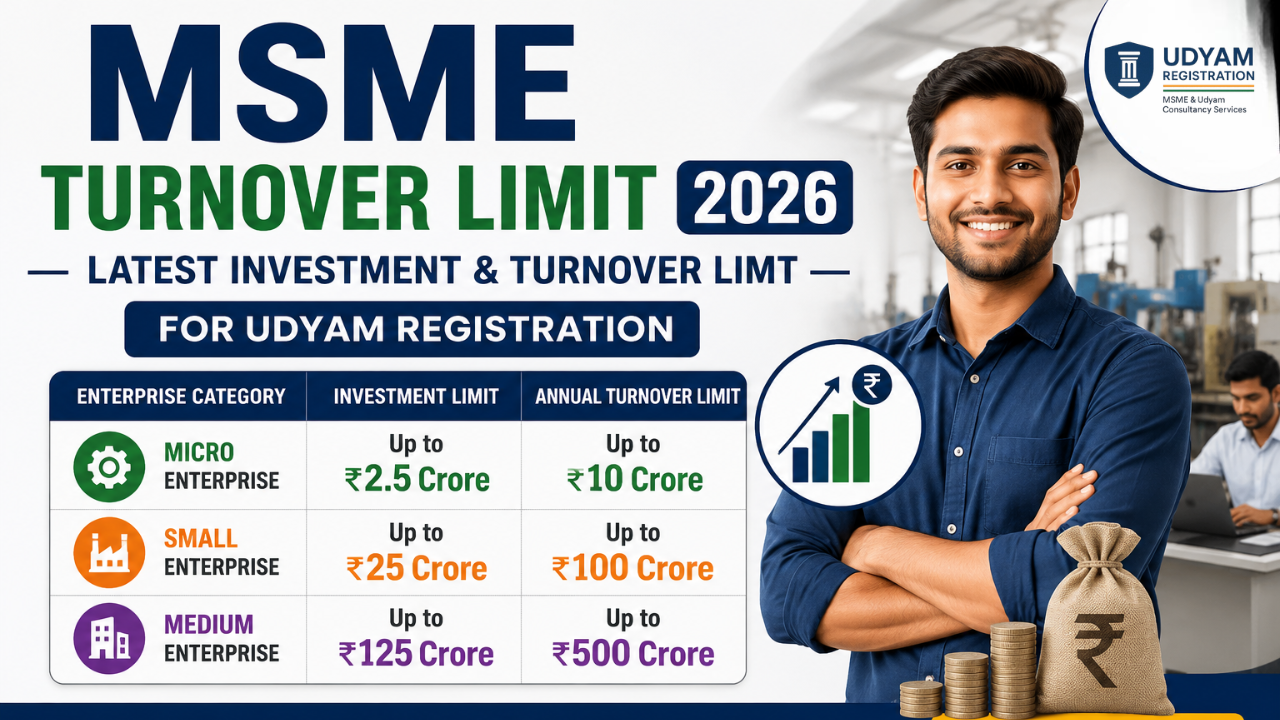
MSME Turnover Limit 2026 | Latest MSME Investment and Turnover Limit | Micro, Small and Medium Enterprises New Definition for Udyam Registration
If you are planning to apply for Udyam Registration, understanding the MSME turnover limit 2026 is essential. The Government of India classifies Micro, Small, and Medium Enterprises based on both investment in plant and machinery/equipment and annual turnover. These limits determine whether your business qualifies as an MSME and which benefits it can access.
The current classification rules, introduced by the Ministry of MSME and used for Udyam Registration, apply equally to manufacturing and service businesses. There is no separate turnover limit for the service sector under the present definition.
MSME Turnover Limit Latest Update 2026
Under the latest MSME definition, businesses are categorized using two criteria:
-
Investment Limit
-
Annual Turnover Limit
A business must satisfy both criteria to fall within a specific category.
MSME Investment and Turnover Limit 2026
|
Enterprise Category
|
Investment Limit
|
Annual Turnover Limit
|
|
Micro Enterprise
|
Up to ₹2.5 Crore
|
Up to ₹10 Crore
|
|
Small Enterprise
|
Up to ₹25 Crore
|
Up to ₹100 Crore
|
|
Medium Enterprise
|
Up to ₹125 Crore
|
Up to ₹500 Crore
|
Micro, Small and Medium Enterprises New Definition 2026
The Government of India revised the MSME classification to make it easier for growing businesses to retain MSME status for longer. The updated limits significantly increased both investment and turnover thresholds, allowing more enterprises to qualify for incentives, credit support, and government procurement benefits.
What is a Micro Enterprise?
A micro enterprise is the smallest business category under the MSME framework. It is ideal for startups, freelancers, home-based units, and small proprietorships.
What is a Small Enterprise?
Small enterprises are more established businesses with larger operational capacity, additional employees, and higher revenue.
What is a Medium Enterprise?
Medium enterprises are larger organizations that still qualify for MSME benefits under the revised definition.
Small MSME Turnover Limit Explained
The term small MSME turnover limit refers to the maximum annual turnover allowed for a business to be classified as a Small Enterprise. As per the latest criteria, the turnover limit for small enterprises is ₹100 crore per year, provided the investment does not exceed ₹25 crore.
Businesses that cross ₹100 crore in turnover or ₹25 crore in investment are moved to the next category, if they meet the medium enterprise criteria.
MSME Turnover Limit for Service Sector
Many entrepreneurs search for MSME turnover limit for service sector, especially those operating consultancy firms, IT companies, digital agencies, hospitals, clinics, coaching institutes, and logistics businesses.
The current rules do not distinguish between manufacturing and service businesses. Both sectors follow the same investment and turnover limits under Udyam Registration.
This means:
-
IT companies can register as MSMEs.
-
Hospitals and clinics can obtain MSME benefits.
-
Professional consultancies are eligible.
-
Digital marketing agencies and software firms qualify.
-
Educational and training institutes can register.
MSME Turnover Limit 2025 vs MSME Turnover Limit 2026
The classification used in 2026 is the same framework currently applied for Udyam Registration and reflects the latest government criteria. If you searched for MSME turnover limit 2025 or MSME turnover limit 2026, you are looking at the same updated thresholds unless the Government of India issues a new notification.
Always verify the latest criteria on the Udyam Registration Portal before filing or updating your registration.
How MSME Turnover is Calculated
The annual turnover considered for MSME classification is generally taken from your filed income tax and GST records, as linked with your PAN and GSTIN. During Udyam Registration, the portal automatically retrieves relevant financial information from government databases, reducing manual errors and paperwork.
Turnover Includes:
Export Turnover Excluded
One of the biggest advantages for exporters is that export turnover is excluded while calculating MSME turnover limits. This helps businesses engaged in international trade retain MSME status even when total receipts are high.
For example:
-
Domestic turnover: ₹95 crore
-
Export turnover: ₹40 crore
-
Turnover considered for MSME classification: ₹95 crore
In this case, the business may still qualify as a Small Enterprise if its investment is within the prescribed limit.
Why MSME Turnover Limit Matters
Knowing the correct MSME turnover limit is important because your enterprise category determines eligibility for a wide range of benefits.
1. Collateral-Free Business Loans
Banks and NBFCs offer easier credit access to registered MSMEs under schemes such as the Credit Guarantee Fund Trust for Micro and Small Enterprises (CGTMSE).
2. Lower Interest Rates
Many financial institutions provide preferential interest rates and processing terms to MSMEs.
3. Government Tenders
Registered MSMEs receive advantages in public procurement, including exemptions and purchase preferences.
4. Protection Against Delayed Payments
Under the Micro and Small Enterprises Facilitation Council, eligible enterprises can seek redress against delayed payments from buyers.
5. Subsidies and Incentives
MSMEs can access reimbursement and subsidy schemes for technology upgrades, certifications, exports, and quality improvement.
MSME Turnover Limit for Udyam Registration
When applying on the Official Udyam Registration Portal, your category is assigned automatically based on PAN-linked investment and turnover data.
You do not need to manually calculate the classification if your tax information is up to date. However, understanding the thresholds helps you plan growth and maintain compliance.
Who Should Apply for Udyam Registration?
Almost every eligible business can benefit from registration, including:
-
Proprietorship firms
-
Partnership firms
-
Limited Liability Partnerships (LLPs)
-
Private Limited Companies
-
One Person Companies (OPCs)
-
Hindu Undivided Families (HUFs)
-
Trusts, societies, and cooperative entities engaged in business activities
Documents Required for Udyam Registration
The registration process is paperless and Aadhaar-based. Common requirements include:
-
Aadhaar number of the proprietor or authorized signatory
-
PAN card
-
GST number (where applicable)
-
Mobile number linked with Aadhaar
-
Business details and bank information
Can Existing Businesses Update Their Category?
Yes. If your investment or turnover changes, the system updates your classification based on filed financial data. A Micro Enterprise can automatically move to Small or Medium as it grows, and businesses can also be reclassified downward if they meet lower thresholds.
This dynamic classification ensures that businesses continue to receive benefits appropriate to their size while supporting expansion without immediate loss of MSME status.
Frequently Asked Questions (FAQs) on MSME Turnover Limit 2026
1. What is the MSME turnover limit in 2026?
The latest MSME turnover limit is up to ₹10 crore for Micro Enterprises, ₹100 crore for Small Enterprises, and ₹500 crore for Medium Enterprises.
2. What is the investment and turnover limit for MSMEs?
MSMEs are classified based on both investment and annual turnover. A business must meet both criteria to qualify under a particular category.
3. What is the small MSME turnover limit?
The turnover limit for a Small Enterprise is up to ₹100 crore, with investment not exceeding ₹25 crore.
4. What is the MSME turnover limit for the service sector?
There is no separate limit for service businesses. Manufacturing and service sectors follow the same criteria.
5. What is the micro enterprise turnover limit?
A Micro Enterprise can have annual turnover up to ₹10 crore and investment up to ₹2.5 crore.
6. What is the medium enterprise turnover limit?
A Medium Enterprise can have annual turnover up to ₹500 crore and investment up to ₹125 crore.
7. Is export turnover included in MSME classification?
No. Export turnover is excluded while determining MSME status.
8. Is GST mandatory for Udyam Registration?
GST is required where applicable under tax law, but registration eligibility depends on your business type and compliance status.
9. Can startups apply for Udyam Registration?
Yes. Startups and newly established businesses can register if they meet the eligibility requirements.
10. Can professionals and consultants register as MSMEs?
Yes. Service-based businesses such as consultants, IT firms, agencies, and clinics are eligible.
11. What happens if turnover exceeds the MSME limit?
Your enterprise may be reclassified into a higher category or may cease to qualify if both criteria exceed the prescribed limits.
12. Can one person register multiple businesses?
Yes, provided each eligible business is properly represented and linked to the relevant PAN and GST details.
13. How is turnover verified?
The system uses PAN and GST-linked data from official government records.
14. Can an MSME upgrade from Micro to Small?
Yes. Classification updates automatically as investment and turnover increase.
15. Is Udyam Registration compulsory?
It is not mandatory for every business, but it is highly beneficial for accessing MSME schemes and incentives.
16. Can existing Udyog Aadhaar holders migrate?
Yes. Earlier registrations were migrated to the Udyam system.
17. Which businesses benefit most from MSME registration?
Manufacturers, exporters, service providers, startups, and growing SMEs gain substantial advantages.
18. Where can I register for Udyam?
You can apply through the Udyam Registration website.
19. Why is understanding the MSME turnover limit important?
It helps determine eligibility for loans, subsidies, tenders, and legal protections available to registered MSMEs.
Conclusion
Understanding the MSME turnover limit 2026 is crucial for every entrepreneur planning to obtain Udyam Registration. The latest classification is based on both investment and turnover and applies uniformly to manufacturing and service sectors.
With turnover limits of ₹10 crore for Micro, ₹100 crore for Small, and ₹500 crore for Medium Enterprises, more businesses can qualify for benefits such as collateral-free loans, government tender advantages, subsidy schemes, and protection against delayed payments.
If your business falls within these thresholds, applying for Udyam Registration can unlock significant growth opportunities and improve your access to formal finance and government support.
