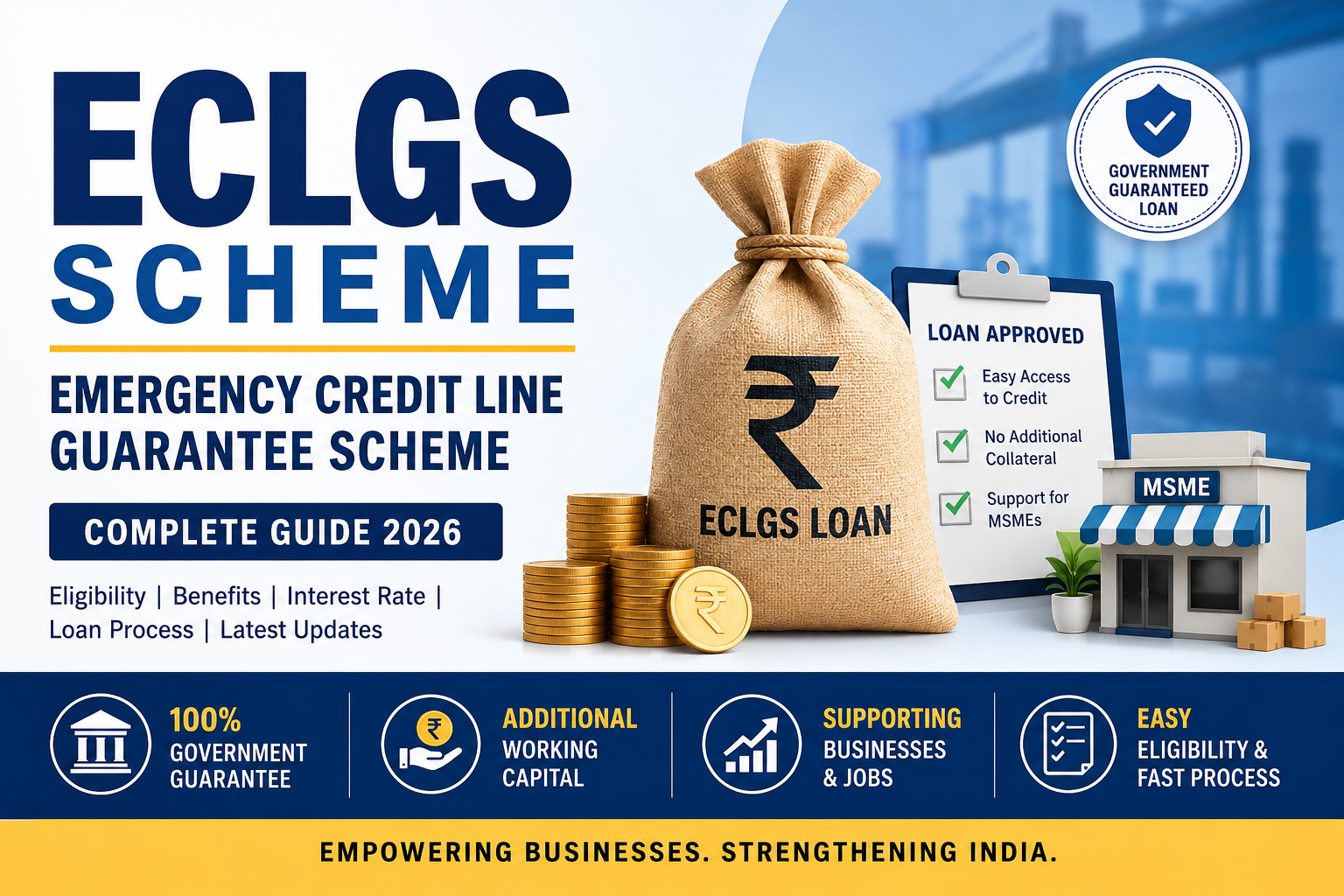
ECLGS Scheme (Emergency Credit Line Guarantee Scheme): Eligibility, Benefits, Loan Apply Process & Latest Updates 2026
ECLGS Scheme (Emergency Credit Line Guarantee Scheme) was introduced by the Government of India to provide financial support to businesses affected during the COVID-19 pandemic. Thousands of MSMEs, business owners, healthcare institutions, professionals, and eligible borrowers benefited from this scheme by receiving additional working capital with a government-backed guarantee. Many businesses that had completed registration through the Udyam Registration Portal were also able to access various MSME-related benefits and financial support schemes, subject to eligibility criteria.
If you are searching for information about the Emergency Credit Line Guarantee Scheme, GECL Loan, ECLGS loan, ECLGS full form, loan eligibility, interest rate, latest updates, or how the scheme worked, this comprehensive guide explains everything in simple language.
What is ECLGS?
ECLGS full form is Emergency Credit Line Guarantee Scheme.
It is a government-backed credit guarantee scheme launched under the Atmanirbhar Bharat Package to help businesses overcome liquidity shortages caused by the pandemic.
Under the scheme, eligible borrowers could receive additional loans from banks and financial institutions while the government provided a 100% guarantee to the lending institutions through the National Credit Guarantee Trustee Company (NCGTC).
The primary objective was to:
-
Support MSMEs
-
Help businesses survive financial difficulties
-
Protect employment
-
Improve business liquidity
-
Encourage banks to lend without fear of default
Emergency Credit Line Guarantee Scheme Overview
|
Particular
|
Details
|
|
Scheme Name
|
Emergency Credit Line Guarantee Scheme (ECLGS)
|
|
Launched By
|
Government of India
|
|
Implemented Through
|
NCGTC
|
|
Beneficiaries
|
MSMEs, Businesses, Professionals
|
|
Loan Type
|
Additional Working Capital
|
|
Government Guarantee
|
Up to 100%
|
|
Security
|
Usually No Additional Collateral
|
|
Lending Institutions
|
Banks, NBFCs, Financial Institutions
|
What is GECL Loan?
GECL Loan stands for Guaranteed Emergency Credit Line Loan.
It is the actual loan provided to eligible borrowers under the ECLGS framework.
Many people search for:
All these terms refer to the additional emergency loan provided under ECLGS with government guarantee support.
ECLGS Loan Meaning
ECLGS loan means an emergency financial assistance loan offered by banks to eligible businesses under the government guarantee scheme.
Unlike regular business loans, these loans were backed by the Government of India, reducing the lender's credit risk and making it easier for businesses to obtain funding.
Objectives of Emergency Credit Line Guarantee Scheme
The major objectives included:
-
Providing emergency liquidity
-
Supporting MSMEs
-
Preventing business closures
-
Saving jobs
-
Encouraging fresh lending
-
Reviving economic activity
-
Strengthening the MSME sector
Who Could Apply for ECLGS?
The scheme covered a wide range of borrowers, including:
ECLGS Scheme Eligibility
The ECLGS scheme eligibility depended on the specific version of the scheme. Generally, borrowers needed to:
-
Have an existing business loan
-
Meet lender eligibility requirements
-
Be within prescribed loan limits
-
Have an eligible outstanding loan amount
-
Satisfy lending institution norms
Banks verified eligibility before sanctioning the loan.
Benefits of ECLGS Scheme
The Emergency Credit Line Guarantee Scheme offered several advantages:
1. Government Guarantee
The government guaranteed the loan, reducing lender risk.
2. Easier Loan Approval
Banks were more willing to lend because of the guarantee cover.
3. No Additional Collateral
Most borrowers were not required to provide fresh collateral.
4. Improved Cash Flow
Businesses received immediate working capital support.
5. Business Continuity
The scheme helped companies continue operations during difficult times.
6. Employment Protection
Businesses could retain employees by managing operational expenses.
7. Affordable Interest Rates
Interest rates were capped according to government guidelines and lender policies.
ECLGS Interest Rate
One of the biggest advantages of the scheme was controlled interest rates.
The ECLGS interest rate varied depending on:
Banks generally followed the maximum interest rate limits specified under the scheme.
ECLGS Loan Interest Rate
When comparing ECLGS loan interest rates, borrowers were advised to check:
Different banks offered slightly different terms within the permitted framework.
ECLGS Loan Apply Process
Many borrowers searched for ECLGS apply and ECLGS loan apply online.
The general application process included:
Step 1: Contact your existing bank or financial institution.
Step 2: Verify your eligibility.
Step 3: Submit the required documents.
Step 4: Complete the loan application form.
Step 5: Bank verification.
Step 6: Loan approval.
Step 7: Loan disbursement.
Documents Required
Typical documents included:
-
PAN Card
-
Aadhaar Card
-
GST Registration
-
Business Registration
-
Udyam Registration
-
Bank Statements
-
Existing Loan Details
-
Financial Statements
-
Income Tax Returns
-
KYC Documents
Banks could ask for additional documents depending on the case.
ECLGS for MSME
The ECLGS for MSME became one of the largest financial relief programs introduced during the pandemic.
It helped MSMEs:
-
Purchase raw materials
-
Pay salaries
-
Manage operational expenses
-
Maintain inventory
-
Restart business activities
-
Meet working capital needs
Thousands of MSMEs across India benefited from the scheme.
MSME ECLGS Scheme
The MSME Emergency Credit Line Guarantee Scheme became particularly important because MSMEs were among the most affected sectors during COVID-19.
Benefits included:
ECLGS 1.0 Scheme
The ECLGS 1.0 Scheme was the first phase introduced by the Government.
It mainly covered:
This phase formed the foundation of the entire ECLGS program.
ECLGS 3.0 Scheme
The ECLGS 3.0 Scheme expanded support to sectors that were severely affected by the pandemic.
These included:
-
Hospitality
-
Tourism
-
Travel
-
Leisure
-
Sports
-
Healthcare
The scheme increased loan limits for eligible borrowers.
ECLGS 4.0 Scheme
The ECLGS 4.0 Scheme further expanded support, particularly for the healthcare sector during the COVID-19 second wave.
It covered:
This phase aimed to strengthen India's healthcare capacity during the public health emergency.
ECLGS RBI Circular
Many borrowers searched for:
-
ECLGS RBI Circular
-
ECLGS 4.0 Scheme RBI Circular
-
ECLGS Scheme RBI Circular 2021
-
ECLGS Scheme RBI Circular 2022
The Reserve Bank of India issued various regulatory guidelines and notifications to facilitate implementation by banks, while operational details were issued by the Government of India and NCGTC. These circulars covered eligibility, restructuring, lending norms, and operational timelines during the scheme's active period.
ECLGS Scheme Extension
The Government extended the scheme multiple times considering the ongoing economic impact of the pandemic.
The ECLGS scheme extension allowed more businesses to access emergency funding and gave eligible borrowers additional time to avail benefits.
ECLGS Latest Update
The ECLGS latest update is that the scheme was a temporary COVID-19 relief measure and new applications are no longer being accepted after the government-declared closure of the scheme.
However:
-
Existing sanctioned loans continue under their repayment terms.
-
Borrowers must repay according to the loan agreement.
-
Banks continue servicing sanctioned loans until closure.
Anyone looking for business finance today should check the latest MSME loan schemes currently available through banks and government initiatives.
Canara Bank ECLGS Scheme
Canara Bank ECLGS Scheme offered eligible customers additional emergency credit under government guidelines.
Features generally included:
-
Working capital assistance
-
Government guarantee
-
Competitive interest rates
-
Flexible repayment
-
Quick processing for eligible customers
HDFC Bank ECLGS Scheme
The HDFC Bank ECLGS Scheme was available for eligible borrowers based on government norms.
Borrowers were required to:
Union Bank of India ECLGS Scheme
The Union Bank of India ECLGS Scheme also participated in implementing the Emergency Credit Line Guarantee Scheme.
Eligible customers could receive additional working capital based on the applicable guidelines during the operational period.
ICICI Bank ECLGS Loan
Several leading private banks, including ICICI Bank, also implemented ECLGS for eligible borrowers.
Customers generally needed to:
-
Hold existing eligible credit facilities
-
Meet the scheme's eligibility criteria
-
Complete bank verification
Emergency Credit Guarantee Scheme vs Regular Business Loan
|
Feature
|
ECLGS
|
Regular Business Loan
|
|
Government Guarantee
|
Yes
|
Usually No
|
|
Purpose
|
Emergency Liquidity
|
General Business
|
|
Additional Collateral
|
Generally Not Required
|
May Be Required
|
|
COVID Relief
|
Yes
|
No
|
|
Eligibility
|
Scheme Based
|
Bank Policy
|
Advantages of ECLGS
-
Government-backed guarantee
-
Better access to finance
-
Reduced lender risk
-
Support for MSMEs
-
Faster business recovery
-
Working capital assistance
-
No fresh collateral in many cases
-
Flexible repayment structure
Limitations of ECLGS
-
Temporary scheme
-
Eligibility restrictions
-
Available only during the operational period
-
Existing borrower requirement in many cases
-
Subject to lender approval
-
Not available for fresh applications after closure
Frequently Asked Questions (FAQs)
1. What is the full form of ECLGS?
Answer: ECLGS stands for Emergency Credit Line Guarantee Scheme, a government-backed scheme launched to provide emergency credit support to eligible businesses affected by the COVID-19 pandemic.
Source: https://www.ncgtc.in/en/product-detail/eclgs
2. What is GECL Loan?
Answer: GECL (Guaranteed Emergency Credit Line) is the additional credit facility provided to eligible borrowers under the ECLGS with a government guarantee.
Source: https://www.ncgtc.in/en/product-detail/eclgs
3. Who launched the ECLGS Scheme?
Answer: The Government of India, under the Atmanirbhar Bharat Abhiyan, launched the Emergency Credit Line Guarantee Scheme in May 2020.
Source: https://www.pib.gov.in
4. What was the objective of the ECLGS Scheme?
Answer: The scheme aimed to provide emergency working capital and liquidity support to businesses affected by the COVID-19 pandemic.
Source: https://www.ncgtc.in/en/product-detail/eclgs
5. Who was eligible for ECLGS?
Answer: Eligible MSMEs, business enterprises, professionals, and certain sectors with existing loans from banks or NBFCs could avail benefits under the scheme, subject to prescribed eligibility conditions.
Source: https://www.ncgtc.in/en/product-detail/eclgs
6. Is the ECLGS Scheme still available?
Answer: No. The Government has closed the scheme for fresh applications. However, existing sanctioned loans continue as per their repayment terms.
Source: https://www.ncgtc.in/en/product-detail/eclgs
7. Was collateral required for ECLGS loans?
Answer: Generally, no additional collateral or fresh guarantee was required for loans sanctioned under the ECLGS.
Source: https://www.ncgtc.in/en/product-detail/eclgs
8. Who provided the guarantee under ECLGS?
Answer: The guarantee was provided by the National Credit Guarantee Trustee Company (NCGTC) on behalf of the Government of India.
Source: https://www.ncgtc.in
9. Could MSMEs apply under the scheme?
Answer: Yes. MSMEs were among the primary beneficiaries of the Emergency Credit Line Guarantee Scheme.
Source: https://msme.gov.in
10. What is the repayment period of an ECLGS loan?
Answer: The repayment tenure varied depending on the applicable version of the scheme and lender guidelines, with moratorium benefits available in several phases.
Source: https://www.ncgtc.in/en/product-detail/eclgs
11. Which banks offered ECLGS loans?
Answer: Most scheduled commercial banks, financial institutions, and eligible NBFCs, including SBI, Canara Bank, Union Bank, HDFC Bank, and ICICI Bank, participated in the scheme.
Source: https://www.ncgtc.in/en/product-detail/eclgs
12. What is the difference between ECLGS and GECL?
Answer: ECLGS is the overall government guarantee scheme, while GECL refers to the actual Guaranteed Emergency Credit Line loan sanctioned under that scheme.
Source: https://www.ncgtc.in/en/product-detail/eclgs
13. Was the ECLGS loan interest rate fixed?
Answer: The scheme prescribed maximum interest rate caps, while the exact rate depended on the lending institution and applicable government guidelines.
Source: https://www.ncgtc.in/en/product-detail/eclgs
14. What were ECLGS 1.0, 3.0, and 4.0?
Answer: These were different phases of the scheme that expanded eligibility and support to additional sectors such as hospitality, tourism, healthcare, and medical infrastructure.
Source: https://www.pib.gov.in
15. Can borrowers who already received an ECLGS loan continue repayment?
Answer: Yes. Existing borrowers must continue repaying their sanctioned ECLGS loans according to the repayment schedule agreed with their bank or financial institution.
Source: https://www.ncgtc.in/en/product-detail/eclgs
Conclusion
ECLGS (Emergency Credit Line Guarantee Scheme) played a vital role in supporting India's economy during one of the most challenging periods in recent history. By providing government-backed emergency credit to MSMEs, healthcare institutions, professionals, and businesses, the scheme helped maintain liquidity, preserve employment, and enable business continuity.
Although the scheme is now closed for new applications, its impact on the MSME sector and the broader economy remains significant. Businesses seeking financing today should explore current MSME loan schemes, government credit guarantee programs, and bank-specific business loan offerings. Understanding how ECLGS worked also provides valuable insight into how emergency financial assistance programs can support businesses during times of economic uncertainty.
